

How Long Did The Makeup Take In The Hunchback Of Notre Dame 1923
Motion-picture show NOTES
FILM NOTES Index
NYS WRITERS Found
HOME PAGE
Classic Moving picture
Series

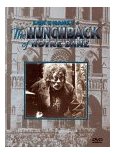 The Hunchback of Notre Dame
(United states of america, 1923, 120 minutes, b&westward, 16mm)
Directed by Wallace Worsley
Cast:
Lon Chaney . . . . . . . . . . Quasimodo
Patsy Ruth Miller . . . . . . . . . . Esmeralda
Norman Kerry . . . . . . . . . .Phoebus de Chateaupers
Kate Lester . . . . . . . . . . Madame de Condelaurier
The post-obit moving picture notes were prepared for the New York State Writers Institute by Kevin Jack Hagopian, Senior Lecturer in Media Studies at Pennsylvania State University:
He was born in 1883, the kid of deaf-mute parents, and by the cease of his life in 1930, he had go the most articulate star of a silent medium. He was Lon Chaney, and in The Hunchback of Notre Matriarch, he achieved one of the many pinnacles of his prolific (over 150 films). His studio promoted him as "The Man of a Thousand Faces" for his astonishing retinue of costume-and-makeup characters, each of them self-designed. But perhaps a more accurate monicker would be "The Man of a Hundred Moods," for, in each of his films, Chaney offered characters who were both demonic and pathetic, both selfish and empathetic, both fell and gentle; in curt, characters who were as paradoxical every bit real people. Chaney's films were chosen "horror films" because of his eccentric and frightening make-upwardly, just what was horrific in them were the things that are horrific in all people, presented in monstrous measure: the strange compulsions, secret sorrows, and self-destructive vendettas that too frequently give perverse meaning to our lives. The physical disabilities Chaney gave his characters in films like The Unknown, Shadows, Due west of Zanzibar, The Penalty, and The Phantom of the Opera were the expressions of those benighted souls' inner torment.
Out of Chaney'south makeup kit came an countless variety of stories, simply Chaney made his characters out of far more than grease paint, fake hair, and dental appliances. It was said that he had "a deafened face"; he had learned to communicate with his parents through his expressions, besides every bit sign linguistic communication. (Indeed, when his mother was dying, she had lost the use of her arms, so mother and son "talked" solely by facial expression.) No actor has ever expressed more with vast, soul-filled optics and soundless mouth than Lon Chaney.
The Hunchback of Notre Dame was not the commencement time Chaney had played a character affected with this condition of the spine. In 1914's Alas and Alack, Chaney played two brothers, ane hunchbacked, and i not. But The Hunchback of Notre Matriarch was perhaps the nearly ambitious project in the history of Universal studios; on it depended the studio's very hereafter. The massive cathedral set, fifty-fifty though partly realized through a special effects perspective technique called a "glass shot," was one of the largest sets built to that time. Chaney quite literally carried the entire flick on his deformed back; as the crippled bellringer Quasimodo, his foredoomed love for the gypsy girl Esmeralda, his incredible acrobatics, and the visible ache his character suffered -- the whipping scene is surely among the most heartbreaking examples of human misery in all of movie theatre -- would cement Universal'southward position as `the business firm of horror' through the 1940's.
Quasimodo terrified everyone, but children who saw the film, in particular, never forgot it. The brilliant author of the supernatural, Ray Bradbury, addicted to the movies equally a boy in Waukegan, Illinois, was one of those wide-eyed kids. Chaney, said Bradbury, was "Someone who acted out our psyche. He somehow got into the shadows inside our bodies. He was able to nail downwardly our hole-and-corner fears, and put them on the screen."
As a male child, an impressionable Orson Welles saw Chaney'south films, and was enraptured by the combination of grotesquery and empathy Chaney brought up from the dark places in the human soul. Equally a child, Welles was thrown out of the Washington Schoolhouse in Madison, Wisconsin, for wearing a Halloween costume so disturbing that his teacher ran screaming from the room; he must surely have been imitating Chaney. Chaney, said Welles in an interview many years later, was "an actor of neat power and enormous eloquence." Welles developed a lifelong fascination for characters built out of make-up and costume, and Lon Chaney's spirit could exist seen in Welles' own neat, larger than life, heavily made-upwards character, Charles Foster Kane.
Afterwards The Hunchback of Notre Matriarch'south success, Chaney was one of Hollywood's most popular stars. When he signed with fledgling MGM, he joined John Gilbert and Greta Garbo as the immature studio's biggest attractions. By the finish of the decade, Chaney's name had get synonymous with horror. He even rated a novelty number in the musical Hollywood Revue of 1929 called "Lon Chaney'south Gonna Go Y'all If y'all Don't Watch Out." Chaney, whose voice in talking pictures proved as unique as his face, was being discussed for the leads in the new wave of horror films which audio would bring to the American screen, films such as Frankenstein and Dracula. Tragically, he was diagnosed with bronchial cancer, and he died equally one of his own characters might take – mute and triumphant.
— Kevin Hagopian, Penn State University
For additional information, contact the Writers Institute at 518-442-5620 or online at https://www.albany.edu/writers-inst.
Source: https://www.albany.edu/writers-inst/webpages4/filmnotes/fns04n10.html
Posted by: baisleyappents1952.blogspot.com
0 Response to "How Long Did The Makeup Take In The Hunchback Of Notre Dame 1923"
Post a Comment