

What Is The Racial Ethnic Religious Makeup Of New Scotland Yard
Faith in England (2011)[1]
Not stated (7.2%)
Other religions (0.four%)

The Church of England is the established country church building in England, whose supreme governor is the monarch. Other Christian traditions in England include Roman Catholicism, Methodism and the Baptists. After Christianity, the religions with the most adherents are Islam, Hinduism, Sikhism, Judaism, Buddhism, Neopaganism, and the Baháʼí Organized religion[ citation needed ]. There are also organisations promoting irreligion, including humanism and disbelief.
Many of England's most notable buildings and monuments are religious in nature: Stonehenge, Westminster Abbey, Canterbury Cathedral and St Paul's Cathedral. The festivals of Christmas and Easter are widely celebrated in the land.
Statistics [edit]
The 2001 and 2011 censuses did not include on adherence to individual Christian denominations, since they were asked only in the Scottish and Northern Ireland censuses and not in England and Wales.[ii] Notwithstanding using the same principle as practical in the 2001 census, a survey carried out in the end of 2008 by Ipsos MORI and based on a scientifically robust sample, found the population of England and Wales to be 47.0% affiliated with the Church of England, which is also the land church, ix.vi% with the Roman Catholic Church building and 8.seven% were other Christians, mainly Free church Protestants and Eastern Orthodox Christians. iv.viii% were Muslim, 3.4% were members of other religions, 5.iii% were Agnostics, 6.8% were Atheists and fifteen.0% were not sure about their religious affiliation or refused to respond to the question.[3]
| Religion | 2001[4] | 2011[1] | ||
|---|---|---|---|---|
| Number | % | Number | % | |
| Christianity | 35,251,244 | 71.7 | 31,479,876 | 59.4 |
| Islam | 1,524,887 | iii.1 | 2,660,116 | v.0 |
| Hinduism | 546,982 | 1.1 | 806,199 | 1.5 |
| Sikhism | 327,343 | 0.vii | 420,196 | 0.eight |
| Judaism | 257,671 | 0.5 | 261,282 | 0.5 |
| Buddhism | 139,046 | 0.3 | 238,626 | 0.5 |
| Other religion | 143,811 | 0.3 | 227,825 | 0.4 |
| No religion | 7,171,332 | 14.6 | 13,114,232 | 24.7 |
| Religion non stated | 3,776,515 | 7.vii | 3,804,104 | vii.2 |
| Total population | 49,138,831 | 100.0 | 53,012,456 | 100.0 |
Organized religion in England and Wales (2008)[iii]
Other Christian denominations (8.seven%)
Other religions (1.4%)
Atheist (6.eight%)
Not sure/refused (xv.0%)
Abrahamic religions [edit]
Christianity [edit]
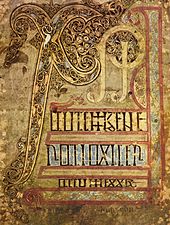
Saint George is recognised as the patron saint of England and the flag of England consists of his cantankerous. Prior to Edward 3, the patron saint was St Edmund and St Alban is also honoured equally England's first martyr. The first Christianity in England prior to the Great Schism of 1054 A.D. was what is now known as Orthodox Christianity, whose saints include Saint Patrick, Saint Ethelbert, Saint Morwenna, and many other English Saints.
Anglicanism [edit]
The established organized religion of the realm is the Church of England, whose supreme governor is Queen Elizabeth Ii although in exercise the is governed by its bishops nether the authorization of Parliament. Twenty-six of the church building'due south 42 bishops are Lords Spiritual, representing the church in the Business firm of Lords. The dioceses of England are divided betwixt the ii provinces of Canterbury and York, both of whose archbishops are considered primates. The church building regards itself as the continuation of the Catholic church building introduced by St Augustine'southward sixth-century mission to Kent, although this is disputed owing to procedural and doctrinal changes introduced by the 16th-century English language Reformation, particularly the Thirty-Nine Articles of Religion and the Book of Common Prayer. In 2010, the Church of England counted 25 1000000 baptised members out of the 41 million Christians in Groovy United kingdom of great britain and northern ireland'south population of about sixty million;[5] [half dozen] around the same time, it also claimed to baptise one in eight newborn children.[seven] Generally, anyone in England may ally or exist buried at their local parish church, whether or not they take been baptised in the church building.[8] Actual omnipresence has declined steadily since 1890,[nine] with around 1 meg, or 10% of the baptised population attending Sunday services on a regular basis (defined as once a month or more) and three million- roughly 15%- joining Christmas Eve and Christmas services.[10] Information technology has around 18 000 active and ordained clergy.[xi]
The Costless Church of England is another Anglican denomination which separated from the Church building of England in the 19th century in opposition to shifts in doctrine and ceremony that brought the established church closer to Roman Catholicism. The Free Church of England is in communion with the Reformed Episcopal Church building in the U.s.a. and Canada.
Catholicism [edit]
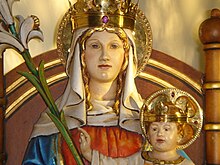
The Catholic Church in England and Wales is directed by its Bishops' Conference, whose electric current president—the Archbishop of Westminster—considers himself the continuation of the come across at Canterbury. The Catholic Church building is forbidden from using the names of the Anglican dioceses by the 1851 Ecclesiastical Titles Human action. Information technology is divided among five provinces headed past the archbishops of Westminster, Liverpool, Birmingham, and Southwark in England and Cardiff in Wales. The Cosmic Church considers itself a continuation of the earliest Celtic Christian communities, although its formal bureaucracy needed to be refounded by the Gregorian mission to the Saxon kingdoms in the sixth and 7th centuries and again following the English Reformation. Papal recognition of George Three as the legitimate ruler of U.k. in 1766 opened the mode for the Catholic Emancipation, easing and ultimately eliminating the anti-Catholic Penal Laws and Test Acts. This process sometimes faced bang-up pop opposition, as during the 1780 Gordon Riots in London. Daniel O'Connell was the start Catholic member of Parliament.[12] The influx of large numbers of Irish gaelic Catholics during the Great Famine of the 1840s and '50s permitted the 1850 papal balderdash Universalis Ecclesiae to formally reconstitute the dormant dioceses of the Catholic Church in United kingdom of great britain and northern ireland. More recently, the royal family has been permitted to ally Roman Catholics without fear of being disqualified from succession to the throne.[13] Recent immigration from Catholic countries, particularly Poland and Lithuania, has increased the church'due south numbers nonetheless more than.[xiv] Polling in 2009 suggested there were virtually v.2 million Catholics in England and Wales, about 9.half-dozen% of the population,[xv] concentrated in the northwest. Some studies testify that weekly attendance at Catholic masses at present exceeds that of the Anglican services.[14]
Other [edit]
No other church in England has more than a million members, with most quite small.

Pentecostal churches are growing and, in terms of church attendance, are now third subsequently the Church building of England and the Roman Catholic Church.[16] There are three main denominations of Pentecostal churches: the Assemblies of God in United kingdom of great britain and northern ireland (part of the World Assemblies of God Fellowship), the Apostolic Church, and the Elim Pentecostal Church. Countess of Huntingdon'due south Connexion is a small society of evangelical churches, founded in 1783, which today has 23 congregations in England. There is besides a growing number of independent, charismatic churches that encourage Pentecostal practices at part of their worship, such equally Kingsgate Community Church in Peterborough, which started with 9 people in 1988 and now has a congregation in excess of one,500.
Various forms of Protestantism developed from the ferment of the English Civil War onwards. The Quakers (formally, the Religious Society of Friends) were founded past George Fox in the 1640s. Post-obit the Great Ejection of 1662, near a 10th of Church building of England ministers gave upwardly their livings, and many of them contributed to diverse forms of Rational Dissent which evolved via English Presbyterianism into, among others, Unitarianism, which notwithstanding has more than than 100 congregations in the 21st century. Methodism developed from the 18th century onwards. The Methodist revival was started in England by a grouping of men including John Wesley and his younger brother Charles every bit a move within the Church of England, but developed equally a separate denomination after John Wesley's death. The primary church in England is the Methodist Church of Great Britain. The Salvation Ground forces dates dorsum to 1865, when it was founded in E London by William and Catherine Booth. Its international headquarters are withal in London, most St Paul'south Cathedral. There is one Mennonite congregation in England, the Wood Dark-green Mennonite Church building in London.[17]
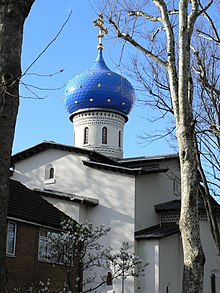
The Cathedral of the Dormition of the Most-Holy Mother of God and the Holy Imperial Martyrs in Gunnersbury.
Almost Greek Orthodox Church building parishes autumn under the jurisdiction of the Archdiocese of Thyateira and United kingdom of great britain and northern ireland, based in London and led by Gregorios,[18] the Archbishop of Thyateira and Nifty Britain. Created in 1932, it is the diocese of the Ecumenical Patriarch of Constantinople that covers England, Wales, Scotland and Ireland every bit well as Malta. A Greek Orthodox customs already existed at the time the UK was formed, worshipping in the Majestic Russian Embassy in London. All the same, it was some other 130 years until an autonomous customs was set up in Finsbury Park in London, in 1837. The offset new church building was congenital in 1850, on London Street in the City. In 1882, St Sophia Cathedral was constructed in London, in lodge to cope with the growing influx of Orthodox immigrants. By the outbreak of World War I, there were big Orthodox communities in London, Manchester and Liverpool, each focused on its ain church. World War Ii and its aftermath likewise saw a large expansion amidst the Orthodox Communities. Today, there are seven churches bearing the championship of Cathedral in London as well equally in Birmingham (the Dormition of the Female parent of God and St Andrew) and Leicester. In addition to these, there are eighty-i churches and other places where worship is regularly offered, twenty-five places (including university chaplaincies) where the divine liturgy is celebrated on a less regular basis, four chapels (including that of the Archdiocese), and two monasteries.[19] Every bit is traditional within the Orthodox Church, the bishops have a considerable degree of autonomy within the Archdiocese. The Greek Orthodox Church of St Nicholas in Toxteth, Liverpool, was built in 1870. It is an enlarged version of St Theodore'southward church in Constantinople and is a Course II Listed edifice.
There are various Russian Orthodox groups in England. In 1962, Metropolitan Anthony (Bloom) of Sourozh founded and was for many years the bishop, archbishop and so metropolitan bishop of the diocese of the Russian Orthodox Diocese of Sourozh, the Moscow Patriarchate's diocese for Great britain and Ireland.[20] It is the most numerous Russian Orthodox group in the land. At that place are also the Russian Orthodox Church Outside Russia churches also equally some churches and communities belonging to the Patriarchal Exarchate for Orthodox Parishes of Russian Tradition in Western Europe's Episcopal Vicariate in the Great britain.
As well equally the Russian and Greek Orthodox churches, in that location are likewise the Serbian Orthodox Church and the Ukrainian Orthodox Church all in London as well as a non-canonical Belarusian Autocephalous Orthodox Church in Manchester. The Antiochian Orthodox Church have the St. George's Cathedral in London and a number of parishes across England.[21]
All Coptic Orthodox parishes fall nether the jurisdiction of the Coptic Orthodox Church of Alexandria Pope of Alexandria. The Coptic Orthodox Church in Britain and Ireland is divided into three chief districts: Ireland, Scotland, and N England; the Midlands and its affiliated areas; and South Wales. In addition, there is 1 Patriarchal Exarchate at Stevenage, Hertfordshire. About British converts belong to the British Orthodox Church, which is canonically part of the Coptic Orthodox Church. At that place is also the Eritrean Orthodox Tewahedo Church and the Ethiopian Orthodox Tewahedo Church in London. At that place is besides the Armenian Churchly Church in London.
Islam [edit]

Muslim population in English language local authority areas.
0.0%–0.9%
1%–ane.nine%
2%–4.9%
5%–9.9%
10%–nineteen.9%
twenty+%
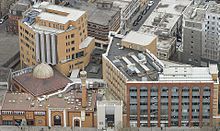
According to the 2011 Census, ii.7 million Muslims live in England where they grade v.0% of the population.[one]
Although Islam is generally idea of as being a contempo arrival to the country, at that place has been contact with Muslims for many centuries. I example is the decision of Offa, the eighth-century Rex of Mercia (one of the Anglo-Saxon kingdoms existing at that fourth dimension), to take coins minted with an Islamic inscription on them—copies of coins issued by the well-nigh-contemporary Muslim ruler Al-Mansur. It is thought that they were minted to facilitate merchandise with the expanding Islamic empire in Spain.[23]
Muslim scholarship was well known amid the learned in England past 1386, when Chaucer was writing. In the Prologue to the Canterbury Tales, there is among the pilgrims wending their way to Canterbury, a 'Doctour of Phisyk' whose learning included Razi, Avicenna (Ibn Sina, Arabic ابن سينا) and Averroes (Ibn Rushd, Standard arabic ابن رشد). Ibn Sina's canon of medicine was a standard text for medical students well into the 17th century.
Today Islam is the second largest religion in England. Nigh 38% of English Muslims live in London, where they brand upwardly 12.four% of the population. There are also large numbers of Muslims in Birmingham, Manchester, Bradford, Luton, Slough, Leicester and the manufacturing plant towns of Northern England.[ane]
Notable mosques include the E London Mosque, London Key Mosque, Al-Rahma mosque, Jamea Masjid, Birmingham Central Mosque, Finsbury Park Mosque, Al Mahdi Mosque, London Markaz and Markazi mosque and the Baitul Futuh Mosque of the Ahmadiyya, which acts equally its national headquarters.
Judaism [edit]

Until the 20th century, Judaism was the only noticeable not-Christian religion having first appeared in historical records during the Norman Conquest of 1066. In fact, from 1290 to 1656, Judaism did not officially exist in England due to an outright expulsion in 1290 and official restrictions that were not lifted until 1656 (though historical records evidence that some Jews did come dorsum to England during the early on function of the 17th century prior to the lifting of the restriction). At present, the presence of the Jewish civilisation and Jews in England today is ane of the largest in the world.
Baháʼí Religion [edit]
The Baháʼí Faith started with the primeval mentions of the predecessor of the Baháʼí Organized religion, the Báb, in The Times on 1 November 1845, only a trivial over a twelvemonth after the Báb offset stated his mission.[24] Today there are Baháʼí communities across the country from Carlisle[25] to Cornwall.[26]
Indian religions [edit]
Hinduism [edit]
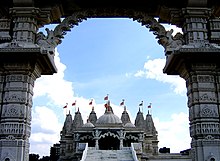
Early Hindus in England were by and large students during the 19th century. There have been 3 waves of migration of Hindus to England since then.
Before Bharat'due south Independence in 1947, Hindu migration was minuscule and largely temporary. The second moving ridge of Hindu migration occurred in the 1970s after the expulsion of Hindus from Uganda. Initially, Hindu immigration was limited to Punjabi and Gujarati Hindus, but, past 2000, minor Hindu communities of every ethnicity could be plant in England. England is also host to a big immigrant community of Sri Lankan Hindus who are mostly Tamils. The terminal moving ridge of migration of Hindus has been taking identify since the 1990s with refugees from Sri Lanka and professionals from India. Nevertheless, there is condign an increasing number of English Western Hindus in England, who accept either converted from another faith or been an English Hindu from nascence.
Sikhism [edit]
The first Sikh Gurdwara (temple) was not established until 1911, at Putney in London.
The first Sikh migration came in the 1950s. It was mostly of men from the Punjab seeking work in industries like foundries and textiles. These new arrivals mostly settled in London, Birmingham and West Yorkshire. Thousands of Sikhs from E Africa shortly followed. This mass immigration was caused past Idi Amin'south persecution of ethnic groups in Uganda, with thousands forced to flee the region in fright of losing their lives.[ citation needed ]
Buddhism [edit]

Buddhist peace pagoda at Battersea Park, London
The primeval Buddhist influence on England came through the United kingdom of great britain and northern ireland's royal connections with Southward East asia, and every bit a event the early connections were with the Theravada traditions of Sri Lanka, Burma and Thailand. The tradition of report resulted in the foundation of the Pali Text Society, which undertook the chore of translating the Pali Canon of Buddhist texts into English.
In 1924 London's Buddhist Society was founded, and in 1926 the Theravadin London Buddhist Vihara. The rate of growth was tedious just steady through the century, and the 1950s saw the development of interest in Zen Buddhism.
In the 1970s, a Theravāda monastic order consists mainly of Westerners following the Thai Wood Tradition of Ajahn Chah was established at Chithurst Buddhist Monastery in W Sussex, and also established branches monasteries elsewhere in the country.
Neopaganism [edit]
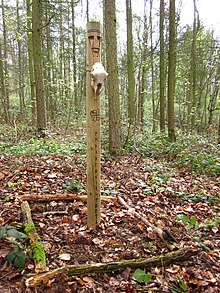
At the 2011 census 75,281[27] people in England identified as Pagan, doubling compared to the figures of the 2001 census. Paganism in England is dominated by Wicca, founded in England itself, the mod movement of Druidry, and forms of Heathenry.
Wicca [edit]
Wicca was adult in England in the first half of the 20th century.[28] Although it had various terms in the past, from the 1960s onward the name of the faith was normalised to Wicca.[29]
Heathenry [edit]
Heathenry is a mod revival of Germanic paganism such as that practiced in the British Isles by the Anglo-Saxon and Norse peoples prior to Christianisation. In the 2011 Census, 1867 people identified specifically equally Heathen.[30]
The largest inclusive Heathen organisation that operates in England is Asatru Great britain, although defective official membership statistics, as of February 2022 had 3177 members of its Facebook grouping.[31] The principal groups that restrict membership based on race are the Odinic Rite and the Odinist Fellowship.
Druidism [edit]
During the Iron Historic period, Celtic polytheism was the predominant organized religion in the surface area now known equally England. Neo-Druidism grew out of the Celtic revival in 18th-century Romanticism. The 2011 census states there are 4,189 Druids in England and Wales.[32] A 2012 assay by the Social club of Bards, Ovates and Druids estimates that at that place are between 6,000 and 11,000 Druids in Britain.[33]
Other religions [edit]
Other religions include:[34]
- Jedi
- Ravidissia
- Rastafari
- Taoism
- Zoroastrianism
- Satanism
- Shintoism
- New Age
- Shamanism
- Scientology
- Traditional African religion
- Animism
- Druze
- Confucianism
- Thelema
- Vodun
- Eckankar
- Brahma Kumari
- Occult
- Reconstructionism
Historical religions [edit]
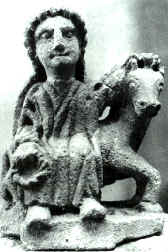
Statue of Epona, a Celtic goddess adopted by the Romans
These faiths, all of which are considered to be pagan, have all been predominant in the regions that after made up England, though were all made extinct through Christianisation.[ citation needed ]
Gallo-Roman religion [edit]
Gallo-Roman faith formed when the Roman Empire invaded and occupied the Brythonic peoples. Elements of the native Brythonic Celtic religion such as the druids, the Celtic priestly caste who were believed to originate in Uk,[35] were outlawed by Claudius,[36] and in 61 they vainly defended their sacred groves from destruction by the Romans on the isle of Mona (Anglesey).[37] However, under Roman rule the Britons continued to worship native Celtic deities, such every bit Ancasta, but often conflated with their Roman equivalents, similar Mars Rigonemetos at Nettleham. The founding of a temple to Claudius at Camulodunum was one of the impositions that led to the revolt of Boudica.
Eastern cults such as Mithraism besides grew in popularity towards the end of the occupation. The Temple of Mithras is one instance of the popularity of mystery religions among the rich urban classes.
Germanic paganism [edit]
In the Dark Ages, immigrants from the European continent arrived, bringing Anglo-Saxon paganism, a subset of Germanic paganism, with them. Later, after most of the Anglo-Saxon peoples had converted to Christianity, Vikings from Scandinavia arrived, bringing with them Norse paganism.
Notable places of worship [edit]
The varied religious and ethnic history of England has left a broad range of religious buildings—churches, cathedrals, chapels, chapels of ease, synagogues, mosques and temples. Also its spiritual importance, the religious compages includes buildings of importance to the tourism industry and local pride. As a result of the Reformation, the ancient cathedrals remained in the possession of the and so-established churches, while most Roman Catholic churches engagement from Victorian times or are of more recent structure (in Liverpool the ultra-modern Roman Cosmic cathedral was actually completed before the more than traditional Anglican cathedral, whose construction took near of the twentieth century). Notable places of worship include:
- Amaravati Buddhist Monastery – Buddhist
- Bevis Marks Synagogue – Jewish
- Birmingham Central Mosque – Islamic
- Brompton Oratory – Roman Cosmic
- Canterbury Cathedral – Church of England
- Finsbury Park Mosque – Islamic
- Gurdwara Sri Guru Singh Sabha – Sikh
- Jamea Masjid – Islamic
- London Buddhist Centre – Buddhist
- London England Temple – Church of Jesus Christ of Latter-day Saints
- Metropolitan Tabernacle – Baptist
- Neasden Temple – Hindu
- Preston England Temple – Church of Jesus Christ of Latter-twenty-four hours Saints
- Salisbury Cathedral – C of E
- Church building of St Lazar – Serbian Orthodox
- St Chad's Cathedral – Roman Catholic
- St Paul'southward Cathedral – Church of England
- Saint Sophia Cathedral – Greek Orthodox
- Stanmore and Canons Park Synagogue – Jewish
- Victoria Park Mosque – Islamic
- Wat Buddhapadipa – Buddhist
- Westminster Abbey – Church of England
- Westminster Cathedral – Roman Cosmic
- Westminster Central Hall – Methodist
- York Minster – Church of England
- Oldham Key Mosque – Islamic
Irreligion [edit]
24.7% of people in England declared no organized religion in 2011, compared with 14.6% in 2001. These figures are slightly lower than the combined figures for England and Wales as Wales has a higher level of irreligion than England.[i] Norwich had the highest such proportion at 42.5%, followed closely by Brighton and Hove at 42.4%.[38]
See also [edit]
- Acts of Supremacy
- Dissolution of the Monasteries
- Gunpowder Plot
- History of the Church building of England
- Putting away of Books and Images Human activity 1549
- Wembley's Conference of Living Religions 1924
- Faith in the United kingdom
- Religion in Birmingham
- Faith in London
References [edit]
- ^ a b c d e "2011 Census: KS209EW Religion, local authorities in England and Wales". ons.gov.u.k.. Retrieved fifteen December 2012.
- ^ Guidance and Methodology, Religion, retrieved 31 January 2014.
- ^ a b "Understanding the 21st Century Catholic Community" (PDF). CAFOD, Ipsos MORI. November 2009. Archived from the original (PDF) on 15 September 2016. Retrieved half-dozen May 2018.
- ^ "Religion (2001 Demography)". data.gov.u.k.. 9 February 2010. Retrieved 17 Dec 2012.
- ^ Gledhill, Ruth (fifteen February 2007). "Catholics prepare to laissez passer Anglicans as leading UK church". The Times. London. Archived from the original on xviii September 2011. Retrieved eighteen February 2015.
- ^ "How many Catholics are there in Britain?". BBC. London. 15 September 2010. Retrieved 18 Feb 2015.
- ^ "2009 Church Statistics" (PDF). Church of England. 2009.
- ^ Meet the pages linked from "Life Events". Church building of England. Archived from the original on 22 November 2010. Retrieved thirteen Feb 2015. .
- ^ Bowler, Peter J. (2001). Reconciling science and religion: the debate in early-twentieth-century United kingdom of great britain and northern ireland. Chicago: Academy of Chicago Press. p. 194. .
- ^ "Facts and Stats". Church building of England.
- ^ "Enquiry and Statistics". Church of England. Retrieved 9 May 2012. .
- ^ Bishop, Erin I. 'My Darling Danny': Letters from Mary O'Connell to Her Son Daniel, 1830–1832. Cork: Cork Academy Press, 1998
- ^ "Regal nod for daughters, Catholics". The Age. Melbourne. 29 October 2011.
- ^ a b Wynne-Jones, Jonathan (23 December 2007). "Uk has get a 'Catholic land'". The Telegraph . Retrieved 18 Feb 2015.
- ^ "Numbers Game," The Tablet, 31 October 2009, sixteen.
- ^ 'Fringe' Church winning the believers The Times, 19 December 2006(subscription required)
- ^ "Who are the Mennonites?". London Mennonite Centre. Retrieved 5 September 2008. [ expressionless link ]
- ^ "Electric current Hierarchs of the Archdiocese of Great Great britain". Orthodox Research Establish. 2008. Archived from the original on 16 March 2002. Retrieved 5 September 2008.
- ^ Archbishop Gregorios of Thyateira & Swell United kingdom (21 Apr 2000). "The Archdiocese of Thyateira and Great United kingdom and Orthodoxy in the British Isles". Archdiocese of Thyateira and U.k.. Retrieved 5 September 2008.
- ^ "Welcome". Russian Orthodox Diocese of Sourozh. Archived from the original on 23 June 2008. Retrieved v September 2008.
- ^ "Parishes, Missions and Clergy". Greek Orthodox Church of Antioch Deanery of the United Kingdom and Ireland. 2008. Retrieved v September 2008. [ permanent dead link ]
- ^ Eade, John (1996). "Nationalism, Customs, and the Islamization of Infinite in London". In Metcalf, Barbara Daly (ed.). Making Muslim Infinite in North America and Europe . Berkeley: University of California Printing. ISBN0520204042 . Retrieved 24 April 2015.
The mosque committee was determined from the start, moreover, to remind local people of the building's religious role as loudly equally possible. As i of the few mosques in Uk permitted to broadcast calls to prayer (azan), the mosque shortly constitute itself at the heart of a public debate about "noise pollution" when local non-Muslim residents began to protest.
- ^ Gold imitation dinar of Offa Archived 12 September 2012 at archive.today, British Museum
- ^ Baháʼí Data Role (United Kingdom) (1989). "Outset Public Mentions of the Baháʼí Faith". Archived from the original on 26 February 2008. Retrieved 18 February 2008.
- ^ The Baháʼí Faith in Cumbria Archived 22 February 2010 at the Wayback Auto bci.org accessed 6 January 2009
- ^ Welcome to the Baháʼís of Cornwall website of Cornish Baháʼís, accessed. 6 Jan 2009
- ^ 2011 ONS results
- ^ Hutton, Ronald (1999). The Triumph of the Moon: A History of Modern Pagan Witchcraft . Oxford, NY: Oxford Academy Press. p. vii. ISBN0-19-820744-one.
- ^ Seims, Melissa (2008). "Wica or Wicca? – Politics and the Power of Words". The Cauldron (129).
- ^ 2011 ONS results
- ^ Asatru U.k. | Facebook Available at: https://world wide web.facebook.com/groups/AsatruUK/members [Accessed February 13, 2022]
- ^ Robert Booth (eleven December 2012). "Census 2011 data on religion reveals Jedi Knights are in decline". The Guardian . Retrieved 11 December 2014.
- ^ "UK 2011 Census Publishes Figures for Druids". The Order of Bards Ovates & Druids. Retrieved 12 January 2012.
- ^ Simon Rogers (11 December 2012). "Census 2011: how many Jedi Knights are there in England & Wales?". The Guardian . Retrieved 11 Dec 2014.
- ^ Julius Caesar, Commentarii de Bello Gallico 6.thirteen
- ^ Suetonius, Claudius 12.5
- ^ Tacitus, Annals fourteen.thirty
- ^ "Differences in religious affiliation across local authorities". Part for National Statistics. Retrieved fifteen December 2012.
External links [edit]
- Reassessing what we collect website History of minority religions in London with objects and images
Further reading [edit]
- Bebbington, David W. Evangelicalism in Mod Britain: A History from the 1730s to the 1980s (Routledge, 2003)
- Chadwick, Owen, The Victorian Church: Vol ane 1829–1859 (1966); Victorian Church building: Office 2 1860–1901 (1979); a major scholarly survey
- Davie, Grace. Religion in Britain since 1945: Believing without belonging (Blackwell, 1994)
- Davies, Rupert E. et al. A History of the Methodist Church building in Great United kingdom (3 vol. Wipf & Stock, 2017). online
- Gilley, Sheridan, and W. J. Sheils. A History of Religion in Uk: Exercise and Belief from Pre-Roman Times to the Present (1994) 608pp excerpt and text search
- Hastings, Adrian. A History of English Christianity: 1920–1985 (1986) 720pp a major scholarly survey
- Hylson-Smith, Kenneth. The churches in England from Elizabeth I to Elizabeth 2 (1996).
- Marienberg, Evyatar. Religion in England from Prehistoric Times to the Early 1980s: With a special accent, when relevant, on Catholicism, and the land's Due north East (2021) 135pp amazon
- Marshall, Peter. "(Re)defining the English Reformation," Journal of British Studies, July 2009, Vol. 48#3 pp. 564–586
- Thomas, Keith. Organized religion and the decline of magic: studies in pop beliefs in sixteenth and seventeenth-century England (1991), a written report of popular religious behaviour and beliefs
- Voas, David, and Alasdair Crockett. "Religion in Britain: Neither believing nor belonging." Sociology 39.one (2005): 11–28. online
Main sources [edit]
- Horace Isle of mann (1854). Demography of Great Britain, 1851: Religious Worship in England and Wales. Ge. Routledge.

What Is The Racial Ethnic Religious Makeup Of New Scotland Yard,
Source: https://en.wikipedia.org/wiki/Religion_in_England
Posted by: baisleyappents1952.blogspot.com
0 Response to "What Is The Racial Ethnic Religious Makeup Of New Scotland Yard"
Post a Comment